Tessera
A Python SDK that gives any LLM agent long-term memory: it extracts facts and episodes from chat turns, handles corrections and forgetting, and returns deterministic ranked recall, with a drop-in MCP server for Claude Code, Cursor, and Codex.
The two things memory libraries skip #
I have tried most of the agent-memory libraries out there, and they felt thin in the same two places. Temporal knowledge: when something happened, and what has since changed or been corrected. And spatial knowledge: how facts relate to each other, not just how similar their embeddings are. Most libraries store vectors and hope. Tessera is my attempt to give those two dimensions a real hand.
Storing embeddings and hoping is not memory. Knowing when a fact was true, and what replaced it, is.
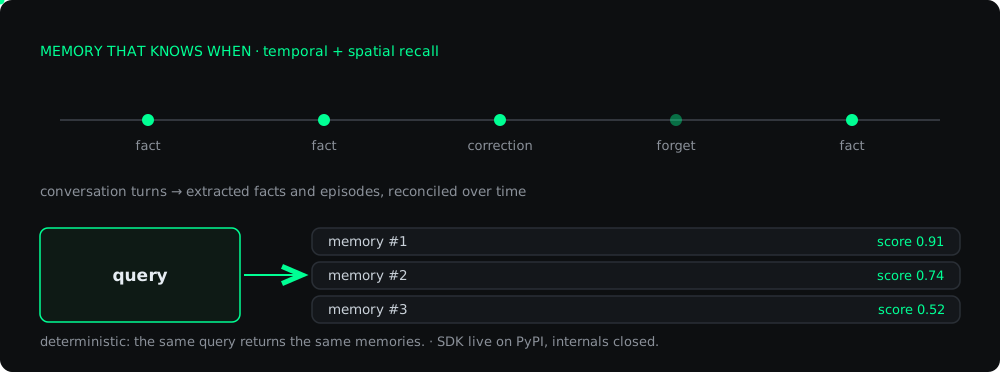
Behaviorally, it extracts facts and episodes from conversation turns, reconciles corrections and forgetting instead of letting contradictions pile up, and returns recall that is ranked and deterministic: the same query gives you the same memories, which matters far more than people admit once you are debugging an agent in production.
Made to drop in #
It is a sync and async Python SDK, and the same engine runs as an MCP server, so an agent in Claude Code or Cursor gets long-term memory without any bespoke plumbing. Give it the conversation, ask it what it remembers, and it hands back a ranked, cited set of memories rather than a blob of concatenated history.
Measuring it honestly #
The hard claim about any memory system is that recall is actually good, so I am building an eval suite to benchmark Tessera against the top memory providers rather than asserting it wins. I would rather know exactly where it loses and fix that than ship a confident README. That work is ongoing, and it is the part I am most interested in getting right.